

Working Principle of RCCB and Its Uses
22nd August 2026 | Written By: Vinod Pottayil | Read Time: 3min | Last Updated: 22nd August 2026
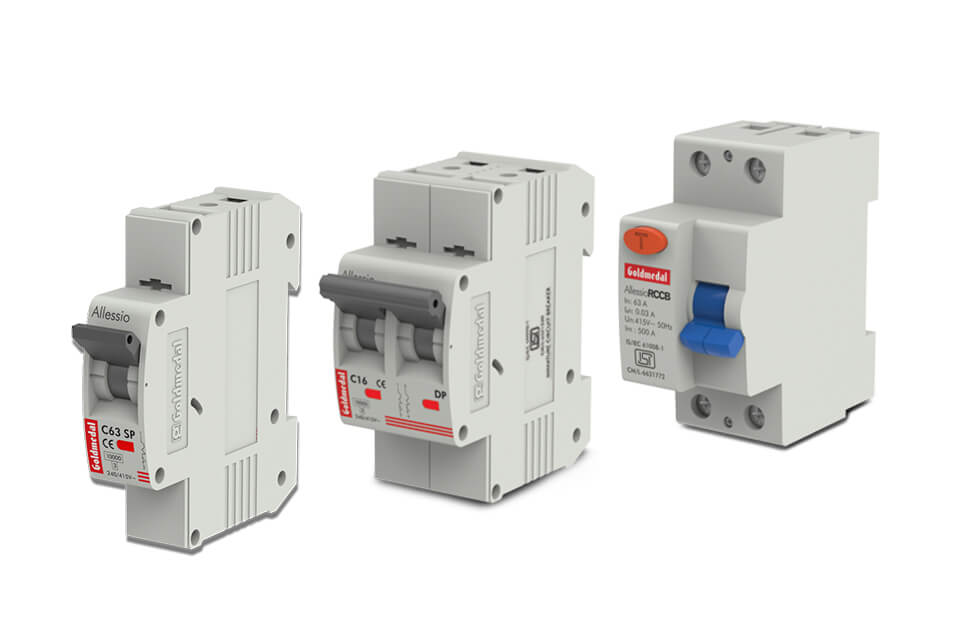
Do you know what protects you from electric shocks and electrical fires? A small yet powerful device called a Residual Current Circuit Breaker (RCCB) quietly performs this life-saving job every day. It can sense issues with currents during sudden electrical faults and switch off power instantly.
Since RCCB is one of the most important electrical safety devices, here is your guide to all you need to know.
Understanding RCCB and Its Benefits
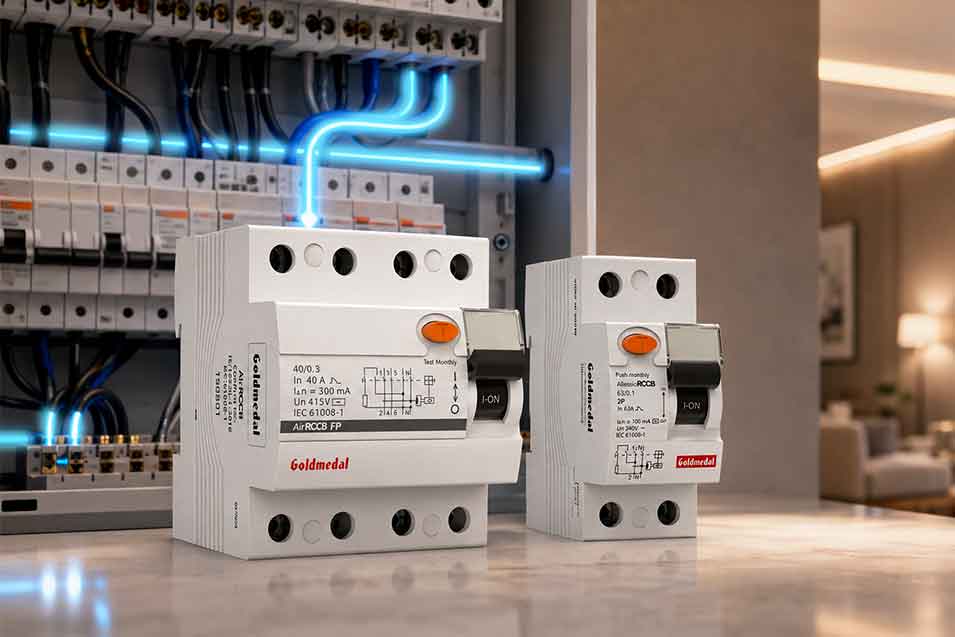
RCCB is located inside the electric panel in your home or office space. It automatically detects the leakage current after which the circuit trips immediately. As a result, it thwarts or minimises risks of major mishaps such as electrical shocks, electrical fires, and electrocution.
For example, you are using a mixer grinder and its power cord has become damaged over time. You accidentally touch an exposed live wire because the insulation has worn off. Electricity may start flowing through your body to the ground. An RCCB detects this leakage of current within milliseconds and disconnects the circuit within milliseconds, helping to prevent a serious electric shock.
RCCB is beneficial in the following ways:
- Protecting people against electric shocks by disconnecting power when it detects earth leakage.
- Safeguarding the property by lowering the risk of electrical fires caused by leakage currents.
- They automatically trip and do not need extensive management after each incident.
Working Principle of RCCB
The RCCB works on Kirchhoff’s Current Law. It states that the current flowing through a live wire should be equal to the current flowing out through a neutral wire. Both live (phase) and neutral wires pass through a current transformer inside an RCCB.
So, RCCB continuously monitors this balance. The moment it senses even the slightest difference between the ingoing and outgoing current, it reacts quickly.
The table below explains the mechanism of RCCB under two conditions: normal and fault.
| Normal Condition | Fault (Earth Leakage) Condition |
|---|---|
| Electricity flows normally through the live wire and returns through the neutral wire. | Some electricity leaks to the earth due to a damaged wire, faulty appliance or accidental contact with a live wire. |
| The current in the live and neutral wires is equal. | The current in the live and neutral wires becomes unequal. |
| The RCCB detects no leakage. | The RCCB detects the imbalance – the leakage. |
| The RCCB allows the power supply to continue. | The RCCB rapidly trips and cuts off the power supply. |
| Electrical appliances work normally. |
|
If RCCB trips frequently, it could be due to a faulty appliance, damaged wiring, moisture, insulation failure, or an actual earth leakage fault. It is advisable to get it checked by a qualified and experienced electrician.
Uses of RCCB
RCCB has uses across different spaces.
- Residential buildings
- Small office spaces, restaurants, shops
- Large commercial complexes – malls, IT and business parks, hotels and resorts
- Hospitals, schools, educational campuses
- Public utility spaces – airports, railway stations, sports stadiums, auditoriums, police stations, fire stations, street lighting
- Industrial spaces – factories, warehouses, logistics hubs, construction sites
- Outdoor installations – garden lighting, water pumps, power sockets, swimming pool, parking area
Types of RCCB
RCCBs are available in different variants based on their sensitivity, current ratings, and safety requirements.
| Type |
|
|---|---|
| Current Rating | Indicates the maximum current the RCCB can safely carry: 25 A, 40 A, 63 A or 100 A |
| Sensitivity | Refers to the amount of earth leakage current required to trip the RCCB. Examples: 30 mA (personal protection), 100 mA (fire protection), 300 mA (industrial applications) |
Limitations of RCCB
While RCCB is a crucial electrical safety device, it comes with a few drawbacks:
- Doesn’t protect against overloads or short circuits (Miniature Circuit Breaker – MCB installation is needed).
- Incorrect or poor installation can affect its performance.
- Needs regular testing to ensure its optimal working mechanism.
Conclusion
An RCCB serves as a vigilant security guard for the electrical layout of your space. As long as electricity flows in balance, it acts as a silent observer in the background. However, the moment even a small amount of electricity leaks happens, it instantly switches off the power as an early hazard detection and prevention. It is a must-have safety device in any property, especially if occupied.

Frequently Asked Questions (FAQs) :
-
Q1. What is an RCCB, and why is it important?
An RCCB is an electrical safety device. It protects you from electric shocks and mitigates the risk of electrical fires caused by earth leakage.
-
Q2. How does an RCCB work?
It continuously monitors the current flowing through the live (phase) and neutral wires. It checks whether incoming and outgoing currents are equal. If it detects a difference due to current leaking to the earth, it immediately trips on its own and disconnects the power supply.
-
Q3. Can RCCB protect property and electrical equipment?
It can lower the risk by protecting against earth leakage. However, it does not protect appliances from overloads, short circuits or voltage surges.
-
Q4. What is the difference between RCCB and MCB?
An RCCB protects against earth leakage and electric shocks. An MCB protects against overloads and short circuits.
Both devices have different uses, and hence both are needed for complete electrical safety.
-
Q5. What factors should be considered while installing RCCB?
Ensure the following:
- It has the correct current rating and sensitivity
- It is compatible with the electrical system.
- It is properly earthed and wired.
- It is installed by a qualified electrician.
- It is used alongside an MCB for complete electrical protection.