

What is a LAN Cable? Understanding Types, Uses, & Differences
21st August 2026 | Written By: Rika Aash | Read Time: 3min | Last Updated: 21st August 2026
In today’s internet-driven world, a stable and high-speed internet connection is essential for homes, offices, and smart devices. While Wi-Fi offers unmatched convenience, a LAN cable remains the preferred choice for faster speeds, lower latency, and dependable data transmission. But what exactly is a LAN cable, and how do you choose the right one? Let’s find out.
What is a LAN Cable?
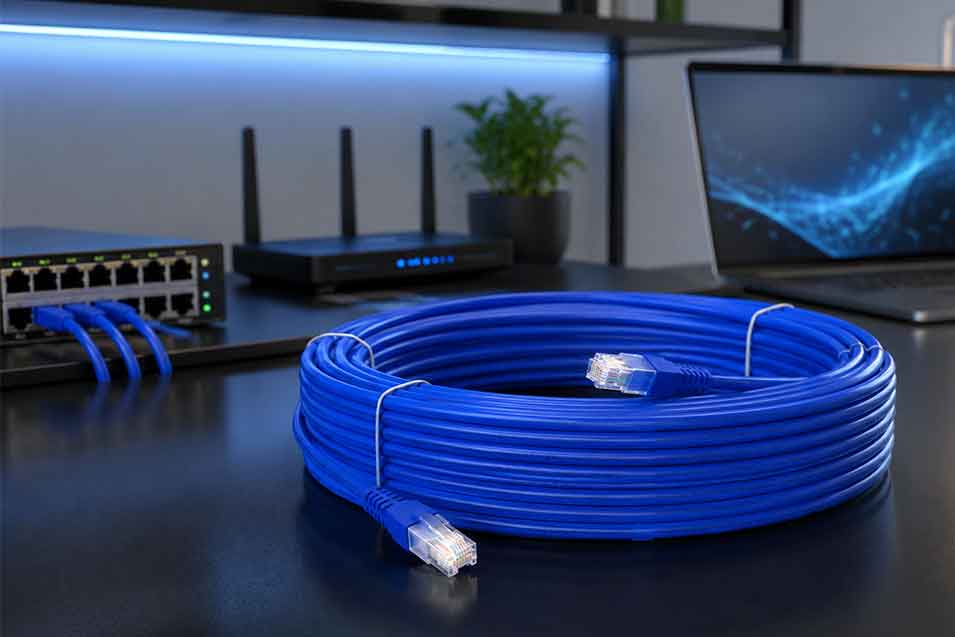
Commonly known as an Ethernet cable, a LAN (Local Area Network) is a networking cable used to connect devices within a local network. It enables data transfer between computers, routers, smart TVs, printers, and other network-enabled devices. Compared to wireless connections, LAN cables provide a direct and secure connection that results in faster internet speeds, minimal signal interference, and greater stability.
Uses of LAN Cables
LAN cables are popularly used across households and commercial environments, including:
- Connecting computers to routers or modems
- Linking switches and network hubs
- Smart TVs and streaming devices
- Gaming consoles for low-latency gaming
- CCTV and IP surveillance systems
- Offices with wired network infrastructure
- Data centres and server rooms
A LAN connection is useful for activities like online gaming, video conferencing, 4K streaming, and large file transfers, where uninterrupted connectivity is important.
Types of LAN Cables
Ethernet cables are classified into different categories based on their speed and bandwidth capabilities.
-
Cat5e Cable:
Cat5e (Category 5 Enhanced) supports speeds of up to 1 Gbps with a bandwidth of 100 MHz. It is suitable for basic home networking and small office setups.
-
Cat6 Cable:
Cat6 cables support speeds of up to 10 Gbps over shorter distances and provide a bandwidth of 250 MHz. They offer better shielding and reduced crosstalk, making them ideal for high-speed internet and business networks.
-
Cat6a Cable:
Cat6a (Augmented Category 6) supports 10 Gbps speeds over longer distances with a bandwidth of 500 MHz. It is commonly used in commercial buildings and enterprise networks.
-
Cat7 and Cat8 Cables:
These are designed for specialised applications such as data centres, industrial networks, and high-performance server environments. They provide higher bandwidth, improved shielding, and exceptional performance for demanding networking requirements.
LAN Cable vs Wi-Fi
While Wi-Fi offers mobility and convenience, LAN cables provide several advantages:
| LAN Cable | Wi-Fi |
|---|---|
| Faster and more stable connection | Speed may fluctuate |
| Lower latency | Higher latency |
| Less interference | Can be affected by walls and other devices |
| Better security | More vulnerable to unauthorised success |
| Ideal for gaming and streaming | Suitable for casual browsing |
For users who require consistent performance, a wired Ethernet connection remains the preferred option.
How to Choose the Right LAN Cable
With so many types of LAN cables available, choosing the right one can be challenging. Consider the following factors before making your selection.
- Internet Speed: Choose a cable that supports your broadband plan.
- Network Usage: For gaming, streaming, or professional work, Cat6 or higher is recommended.
- Cable Length: Longer cables may affect performance if the category is not suitable.
- Installation Environment: Indoor and outdoor installations require different cable types and insulation.
- Future Readiness: Investing in higher-category cables can support faster networks as technology advances.
Conclusion
A LAN cable is the backbone of a reliable wired network, offering superior speed, stability, and security compared to wireless connections. Whether you’re setting up a home office, gaming station, or enterprise network, choosing the right Ethernet cable ensures smooth and uninterrupted connectivity. By understanding the different cable categories and their applications, you can build a network that delivers optimal performance today while remaining ready for future networking demands.

Frequently Asked Questions (FAQs) :
-
Q1. Is LAN better than Wi-Fi?
Yes. A LAN connection offers faster speeds, lower latency, and more stable performance than Wi-Fi, making it ideal for gaming, video conferencing, large file transfers, and uninterrupted streaming. However, Wi-Fi provides the convenience of wireless connectivity and greater mobility.
-
Q2. What do you plug a LAN cable into?
A LAN cable plugs into an Ethernet port on both the device and the network source. One end connects to your computer, laptop, gaming console, smart TV, or printer, while the other connects to a router, modem, network switch, or wall-mounted Ethernet socket to establish a stable wired internet connection.
-
Q3. Is a LAN cable the same as an Ethernet cable?
Yes. LAN cable and Ethernet cable are commonly used to describe the same cable. Technically, Ethernet refers to the networking technology, while a LAN cable is the cable used to create a Local Area Network (LAN).
-
Q4. Is wired LAN faster than 5G?
Yes. A wired LAN (Ethernet) connection is typically faster, more stable, and has lower latency than a 5G wireless connection. It offers consistent speeds with minimal interference, making it ideal for gaming, video conferencing, large file transfers, and high-resolution streaming.