


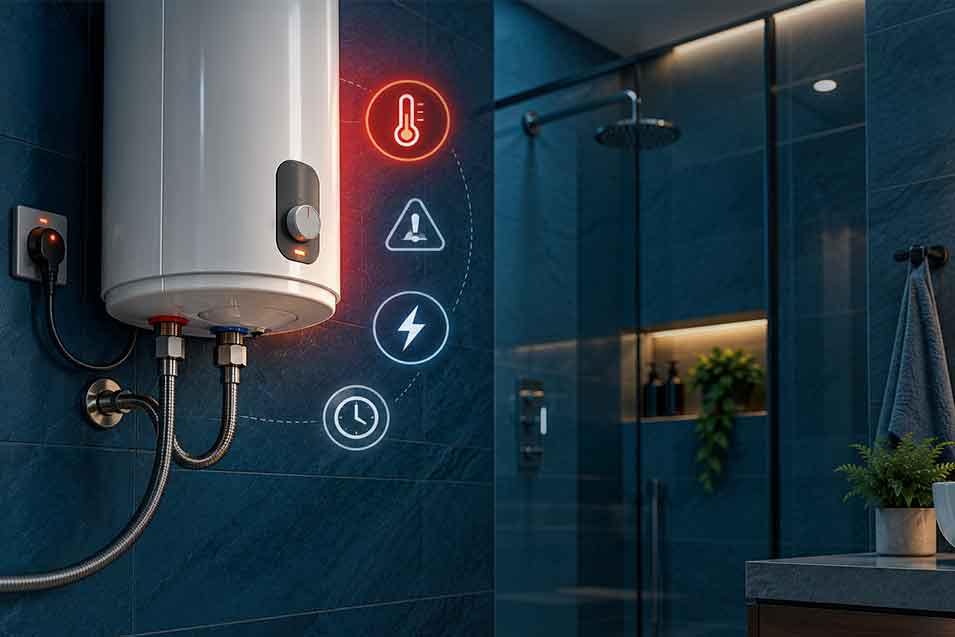
What Happens If a Geyser Is Left On? Risks & Safety Tips
09th September 2026 | Written By: Rika Aash | Read Time: 3min | Last Updated: 09th September 2026
Geysers are essential household appliances widely used in homes. They provide instant hot water and add comfort to daily routines. However, it is important to use them correctly, as leaving a geyser switched on for too long can affect its performance. Although modern geysers are designed with advanced safety features such as thermostats and automatic cut-off mechanisms, proper usage is still essential. In this blog, let us understand what happens when a geyser is left on for too long after use.
What happens when a geyser is left on for 2 hours?
Leaving the geyser on continuously for two hours is not immediately dangerous, but it wastes a lot of electricity. Modern geysers take up to 15–30 minutes to heat water. Keeping the geyser on for a longer time forces the thermostat to cycle repeatedly, increasing wear on electrical components.
What happens when a geyser is left on for 12 hours?
Leaving a geyser on for 12 hours after use can be dangerous. Prolonged operation can put strain on the thermostat and pressure valve. If either fails, the following issues can arise:
- Overpressure within the tank that may lead to leaks or ruptures.
- Excessive electric consumption, leading to higher electricity bills.
- The risk of electrical faults may increase due to overheating or short circuits in older geysers.
Having dedicated circuits and stabilisers helps control voltage fluctuations, which can extend the lifespan of geysers and ensure stable operation in the long run.
What happens when a geyser is left on without water?
Leaving a geyser on without water inside the tank can pose one of the greatest risks. In such cases, the heating element can overheat rapidly and burn out, as it relies on water for heat dissipation. This may also lead to the melting of nearby insulation or cause electrical fires. Preventive safety features can help reduce such risks.
Safety tips for using a geyser
- Switch off when not in use: Make it a habit to turn off your geyser after use.
- Schedule regular maintenance: Check the thermostat, automatic cut-off mechanism, wiring, and pressure valve at regular intervals.
- Use circuit breakers and surge protectors: These help cut off or protect the power supply in case of voltage fluctuations or electrical faults.
- Get professional installation: Ensure the geyser is installed by a qualified technician, with appropriate electrical protection and proper earthing.
- Do not ignore leaks: Even a small leak around electrical connections or the geyser body should be investigated promptly.
Conclusion
Leaving a geyser on for a long time after use can cause overheating, waste energy, reduce its efficiency and even lead to adverse effects, depending on the duration and conditions under which it is left on. Despite the advanced safety features in modern geysers, relying solely on them may not be enough. Simple preventive measures, such as switching off the geyser after every use and scheduling regular maintenance, can help ensure safe operation and extend the lifespan of the geyser.

Frequently Asked Questions (FAQs) :
-
Q1. Does leaving a geyser on increase electricity consumption?
Yes. Leaving a geyser switched on can increase electricity consumption, as the thermostat periodically reheats the water to maintain the set temperature.
-
Q2. How long is it safe to keep a geyser on?
It is generally safe to keep a geyser on until the water reaches the desired temperature. Once heated, switching it off helps avoid unnecessary reheating and electricity consumption.
-
Q3. What is the lifespan of a geyser?
A well-maintained geyser typically lasts around 8–12 years, depending on water quality, usage, installation and regular maintenance.
-
Q4. What happens if a geyser is not used for a long time?
If a geyser is not used for a long time, stagnant water and mineral deposits may build up inside the tank, potentially affecting performance. Before reuse, it is advisable to flush the tank and check the unit for proper operation.
-
Q5. Does a geyser blast if kept on?
A geyser does not normally blast if its thermostat, safety valve and thermal cut-out are functioning correctly. However, excessive pressure or failure of safety components can create a serious hazard, so regular maintenance is important.


