

Regular fan vs Industrial fan: What is the difference, which one to choose?
30th June 2026 | Written By: Rika Aash | Read Time: 5min | Last Updated: 30th June 2026
Fans are one of the most commonly used appliances, whether in homes, offices, factories or warehouses. However, fans used in homes won’t be efficient for use in factories or warehouses. This is why it is important to understand the difference between a regular and an industrial fan. In this blog, we will understand how regular fans and industrial fans function.
What is a regular fan?
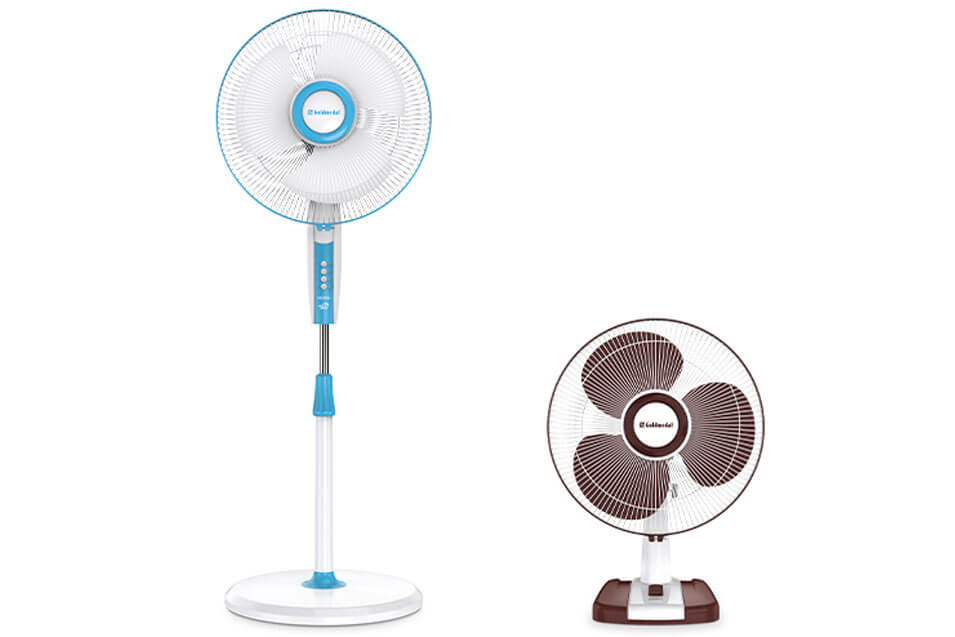
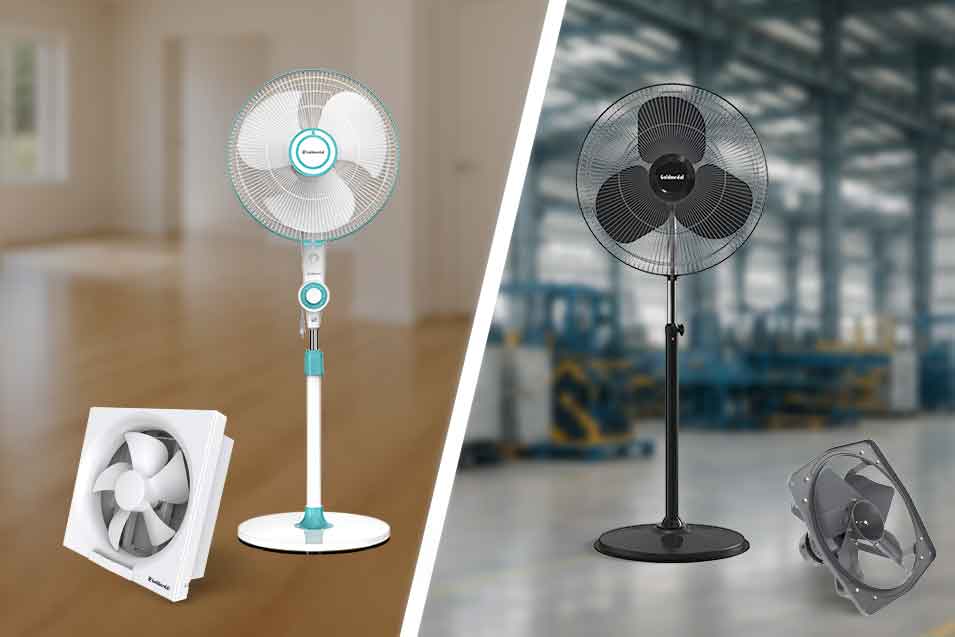
A regular fan is commonly used in households, offices, retail outlets, and indoor spaces where moderate airflow is sufficient. Regular ceiling fans, pedestal fans, and table fans fall under this category. Aesthetically designed, these fans are energy-efficient and perform silently. Some of the modern regular fans are available with advanced features such as BLDC motors, remote controls, timer settings, and smart connectivity.
Features:
- Ideal for domestic and light commercial use
- Moderate airflow and air pressure performance
- Best suited for standard operating conditions
- Not designed for demanding industrial environments
What is an industrial fan?
An industrial fan is built for large-scale and heavy-duty applications. It is widely used in factories, warehouses, workshops, manufacturing plants, gyms, and large commercial spaces where strong and continuous airflow is required. An industrial fan is powered by a heavy-duty motor, with durable metal construction and larger blade spans to deliver maximum air circulation across expansive areas.
Features:
- Prioritise performance and durability over decorative appeal
- Ideal for continuous and heavy-duty use
- Powerful airflow and high-pressure performance
- Heavy-duty and durable metal construction
- Built to withstand dust, heat, moisture, and fumes
- Reliable long-term performance with proper maintenance
Difference between Regular Fans and Industrial Fans
-
Airflow:
Regular fans are designed for small to medium-sized rooms to provide good airflow in enclosed spaces. On the contrary, industrial fans generate significantly higher airflow and can operate at higher pressures. They are widely used for ventilation, removing heat, fumes, dust, and cooling larger areas.
-
Noise levels:
Regular fans are quieter and are suitable for bedrooms, living rooms, study rooms, and offices. Industrial fans due to their powerful motors and high-speed operation, tend to produce more sound and are therefore better suited for industrial or commercial settings where noise is less of a concern.
-
Durability:
Regular fans are designed for standard day-to-day use, whereas industrial fans are built to withstand continuous operation, harsh environments, dust, moisture, and heavy-duty usage. Their robust construction ensures reliable performance even in challenging conditions.
-
Application:
Regular fans are commonly used in homes, offices, retail stores, restaurants, and small commercial spaces where comfortable airflow and quiet operation are required for everyday cooling. Industrial fans are designed for factories, warehouses, workshops, commercial kitchens, and large commercial spaces where powerful airflow, ventilation, and heat or fume extraction is essential.
| Features | Regular Fans | Industrial Fans |
|---|---|---|
| Airflow | Moderate airflow for personal comfort | High-volume airflow for large areas |
| Noise Levels | Quiet Operation | Higher noise levels due to powerful motor |
| Durability | Suitable for everyday indoor use | Built for continuous operation in demanding environments |
| Speed | Optimised for residential comfort | Designed for maximum air circulation |
| Motor Power | Lower power consumption | Higher power output for heavy-duty performance |
| Application | Homes, apartments, hotels, offices | Manufacturing units, warehouses, gymnasiums, hangars, and commercial facilities |
Which one to choose? Regular Fan or Industrial Fan?
When deciding which fan to choose, the size and purpose of the space play a major role. If comfort, style, energy efficiency, and silent operation are what you look for, then a regular fan works best for you. However, if you seek powerful airflow, ventilation, and cooling for large commercial or industrial areas, then an industrial fan is a practical and efficient solution.
Thanks to technological advancements, today both regular and industrial fans are available with energy-efficient motors and smart features that allow users to enjoy improved performance. Choosing the right fan depends on several factors like your cooling needs, space, and usage patterns. Understanding the difference between the two fans will help you select the most suitable fan according to your requirements.