


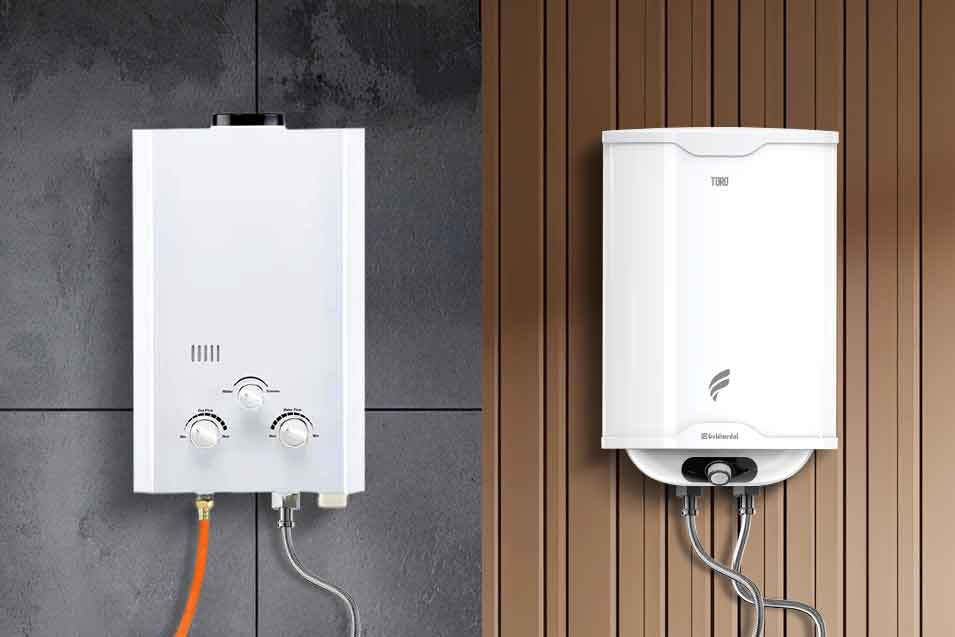
What’s the Difference? Gas Geyser vs Electric Geyser – Which one to choose & What is the Difference.
01st August 2025 | Written By: Utsavi Tank | Read Time: 3min | Last Updated: 18th June 2026
After a long and tiring day, a warm, relaxing shower can be the perfect way to unwind. Choosing the right water heater plays an important role in ensuring a comfortable and convenient experience. Among the various options available, gas geysers and electric geysers are the two most common choices. While both are designed to heat water, they differ in their working mechanisms, safety features, installation requirements, and overall performance. Understanding these differences can help you select the option that best suits your household needs and lifestyle.
Which Geyser Is Better for Indian House?
Choosing between a gas and electric geyser depends on your household needs and fuel availability. Gas geysers typically have lower running costs and provide instant, continuous hot water, making them suitable for larger families or homes with reliable PNG/LPG connections and proper ventilation. Electric geysers, on the other hand, are easier to install, safer for enclosed spaces, and ideal for smaller households or areas without gas supply. If you prioritise cost efficiency and high usage, a gas geyser may be better; if convenience and simple installation matter more, an electric geyser is a practical choice.
Gas Geyser vs Electric geyser
| Feature | Electric Geyser | Gas Geyser |
|---|---|---|
| Cost of product | Instant electric geyser: ₹6,000 – ₹8,000 | Instant gas geyser: ₹4,000 – ₹5,000 |
| Safety | Extremely safe | Not very safe; risk of gas leakage |
| Time Consumption | Takes slightly longer | 3 times faster than electric geyser |
| Space Consumption | Needs only wall-mounting space | Requires extra space for LPG cylinder + ventilation |
| Life Span | 7–10 years | Burners may get damaged frequently |
| Installation | Easy and straightforward | More complicated (gas connection & ventilation) |
| Fuel for Energy | Electricity | LPG/PNG gas |
| Environmental Impact | No direct pollution | May release toxic carbon monoxide |
| Warranty | At least 2 years | 1–2 years |
What is a Gas Geyser?
A gas geyser is a water heating appliance that uses LPG or natural gas as fuel to heat water instantly. Unlike storage heaters, it operates on-demand, heating water only when the tap is turned on. Gas geysers are known for their fast-heating performance and lower running costs in areas where gas is easily available. They are commonly used in households that require continuous hot water supply and prefer fuel-based heating over electricity.
How Does a Gas Geyser Work?
A gas geyser heats water instantly when you open the hot-water tap. First, water starts flowing through the geyser, which activates a sensor and ignites the burner (via battery or auto-ignition). The gas burner then heats a heat exchanger, and as water passes through it, the water temperature rises quickly. The heated water flows out to the tap, and once you close the tap, the burner shuts off automatically—saving fuel and ensuring on-demand hot water.
Key Components Inside a Gas Geyser
A gas geyser consists of several essential components that ensure safe and efficient water heating. The gas burner generates heat, while the heat exchanger transfers that heat to the flowing water. A water flow sensor activates the burner when the tap is opened. The ignition system (battery or auto-ignition) lights the burner, and the control knob/thermostat helps regulate temperature. Safety features such as a flame failure device and overheat protection ensure secure operation during use.
Types of Gas Geysers:
- Instant Gas Geysers – heats water instantly as it flows through the geyser. It is ideal in small families or kitchen usage.
- Storage Gas Geysers – stores certain amount of water in the tank before heating. Suitable for larger households and multi-point needs.
-
Advantages of Gas Geyser
- Complete control of the level and rate of heating
- They can run on both, pipeline and gas cylinders
- Ideal for large families
- Easy to repair and maintain
- Doesn’t require electricity
-
Disadvantages of Gas Geyser
- Shorter durability
- High risk of gas leak
- Not environment friendly
Gas Geyser Running Cost vs Electric Geyser
Gas geysers generally have lower running costs compared to electric geysers, especially in regions where gas prices are competitive. A gas geyser heats water instantly using LPG or PNG, consuming fuel only when hot water is needed. Electric geysers, however, draw continuous power from the grid, and higher electricity tariffs can increase monthly costs. While the exact savings depend on local gas and electricity rates, gas geysers typically deliver hot water more efficiently, resulting in lower energy expenses over time.
What is an Electric Geyser?
As the name suggests, electric geysers run on electricity. They are widely used in urban households, due to their convenience, stable electric supply, and ease of installation. An electric geyser uses a copper coil that heats the water flowing through it.
How Does an Electric Geyser Work?
An electric geyser heats water using an internal electric heating element. When the geyser is switched on, electricity flows to the heating element, which warms the water stored inside the tank. A built-in thermostat monitors the temperature and automatically switches the heater off once the desired temperature is reached. When hot water is used, fresh cold water enters the tank and is heated again. This cycle ensures a steady supply of hot water while maintaining controlled and safe operation.
Instant vs Storage Electric Geyser
An instant electric geyser heats water on demand, delivering hot water immediately without storing it. It is compact and energy-efficient, ideal for small spaces and limited usage. A storage electric geyser heats and stores water in a tank, keeping it ready for use. It suits higher hot-water needs but may consume more electricity due to heat loss from stored water. Choose an instant geyser if you have limited space, require hot water for short durations, or want better energy efficiency. Opt for a storage geyser if your household has higher hot-water demand, such as for showers and multiple users, and you need a continuous supply of hot water at once.
-
Advantages of Electric Geyser
The main advantage of an electric geyser is its convenience. It allows you to get hot water with just the flip of a switch. Other advantages include:
- They are easy to install and handle
- They heat water very quickly
- They tend to be safer as there is no direct fuel involved
- The energy source is relatively cheap
- They have a longer life span and are durable
-
Disadvantages of Electric Geyser
- Rely largely on a constant power source to function.
- Tend to be expensive to purchase, operate and maintain.
Which Geyser Is Better for Indian House?
Choosing between a gas and electric geyser depends on your household needs and fuel availability. Gas geysers typically have lower running costs and provide instant, continuous hot water, making them suitable for larger families or homes with reliable PNG/LPG connections and proper ventilation. Electric geysers, on the other hand, are easier to install, safer for enclosed spaces, and ideal for smaller households or areas without gas supply. If you prioritise cost efficiency and high usage, a gas geyser may be better; if convenience and simple installation matter more, an electric geyser is a practical choice.
Conclusion
While both have their pros and cons, and the final choice largely depends on your specific household needs, energy availability, and safety preferences.
- A gas geyser is better in case you require reduced operational costs and an assured gas supply with proper ventilation.
- An electric geyser is an ideal low-maintenance, reliable option where electricity is available.
Whatever your choice, ensure proper installation by a certified technician and carry out routine maintenance to keep the system in an efficient and safe working condition.

Frequently Asked Questions (FAQs) :
- Q1. Are gas geysers safe for indoor use in apartments? Gas geysers are generally not safe for indoor use without proper ventilation, as they emit carbon monoxide. Use electric instant geysers instead.
- Q2. Can a solar water heater replace gas or electric geysers? Yes, a solar water heater can replace gas or electric geysers for most of the year. Get a backup electric or gas unit for cloudy or rainy days.
- Q3. What is the average lifespan of gas vs electric geysers? Gas geysers can function for at least 6–8 years while electric geysers on the other hand typically last for 8–12 years.


