

High Air Delivery Ceiling Fans – Why are They Important?
11th April 2026 | Written By: Vinod Pottayil | Read Time: 3min | Last Updated: 11th April 2026
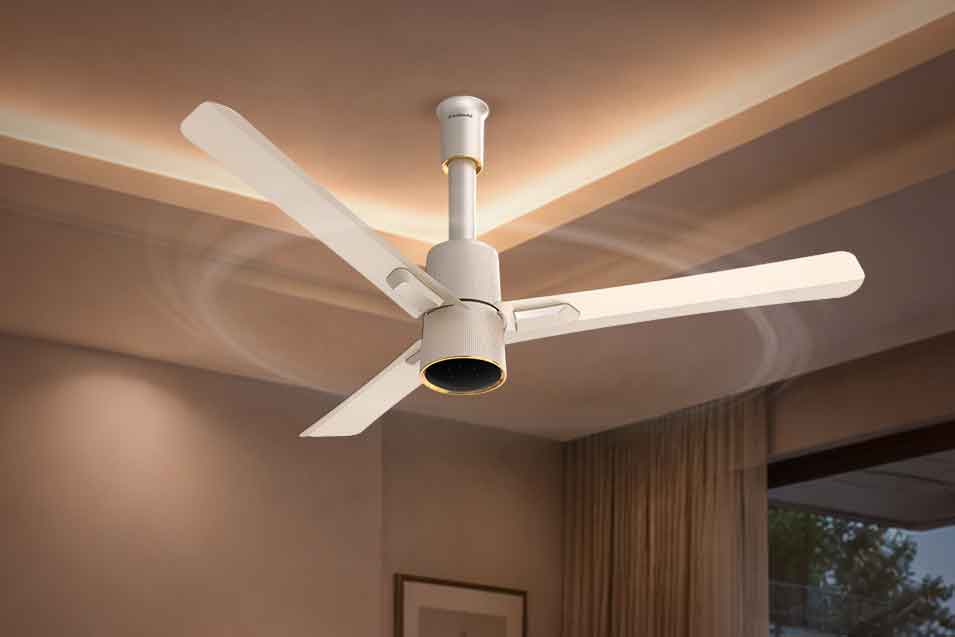
High air delivery ceiling fans are a boon for the Indian climate, especially during the hot and humid summers. These fans circulate more air in the space and enhance the overall quality of indoor air. They also create a natural cooling environment.
Let’s understand further what high air delivery ceiling fans are, why they are important and how they are different from high-speed fans.
Mechanism of High Air Delivery Ceiling Fans
High delivery ceiling fans follow a core principle:
Airflow = Speed × Volume
This means that its blades not only move faster, but they also move more air per rotation. They circulate a large volume of air efficiently and uniformly in all directions, extending to even walls and corners.
As a result, its cooling effect and air flow feel more powerful even at an average speed.
High CMM of Air Delivery Ceiling Fans
Cubic Metres Per Minute (CMM) is the measurement of air volume – how much air a fan can move or how much air you can actually feel. Higher the CMM, better the cooling is.
A regular ceiling fan delivers 200-230 CMM. Hence, it is usually recommended for small rooms.
High air delivery fans deliver 250-300+ CMM, which makes them ideal for hot weather, spacious rooms, or homes without air conditioners.
A high air delivery fan can deliver high CMM due to the following factors:
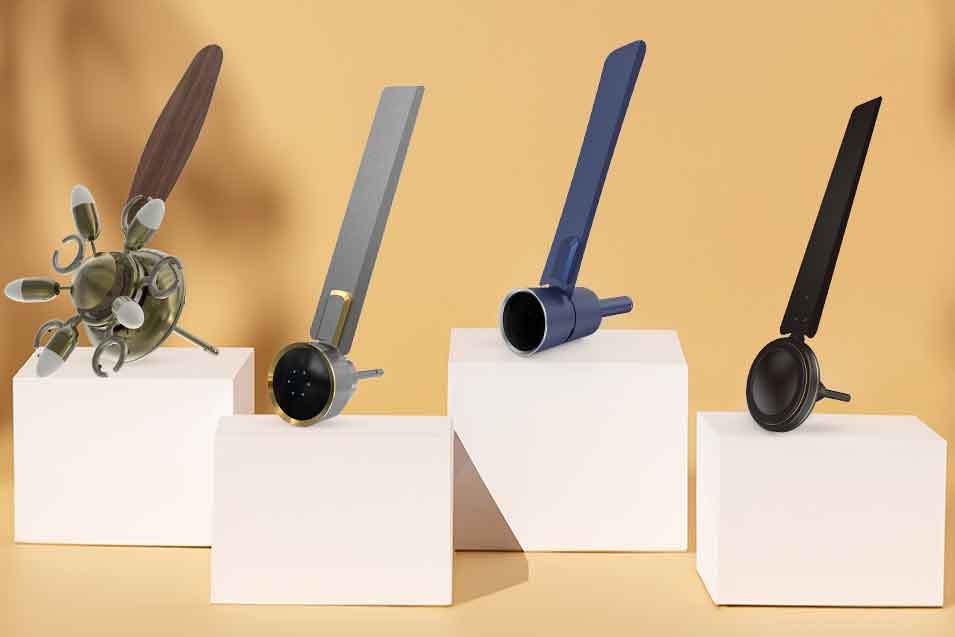
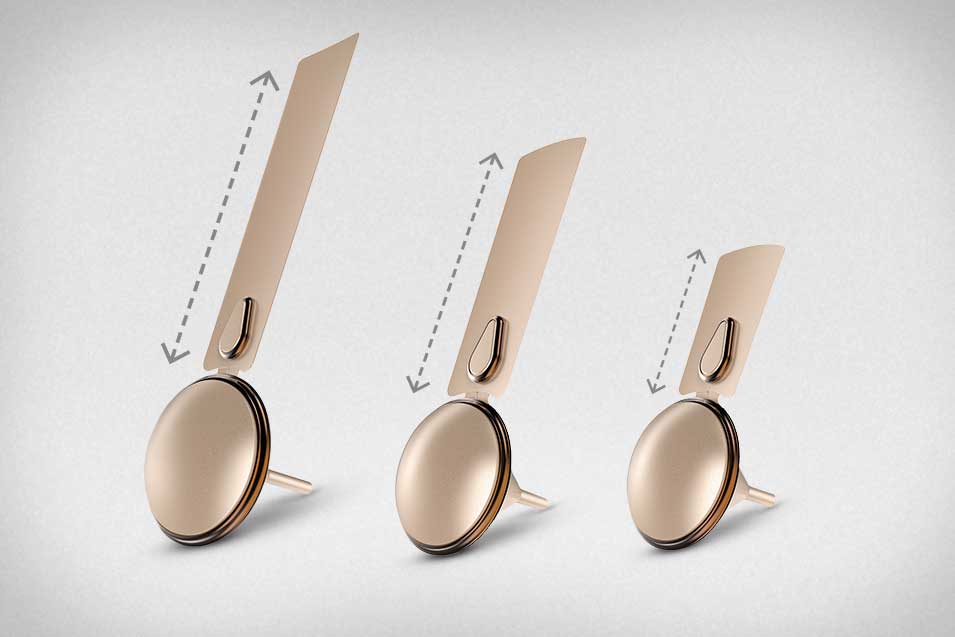
- Blade Design: It has wider blades which scoop more air without any resistance to move more air.
- Brushless Direct Current Motor (BLDC) Efficiency: The energy loss in BLDC motor fans is less. This allows more electrical energy to convert into more air movement. So, there is higher CMM even at low power consumption.
- Balanced Rotation: The high air delivery fan rotates smoothly without wobbling or resistance. It saves energy wastage and gives strong, even airflow. So, they deliver full CMM efficiency.
Are All High Airflow Fans BLDC Fans?
No.
Most high airflow fans available in the market are BLDC fans. This is because BLDC delivers CMM at low electricity.
Other non-BLDC high airflow fans use strong AC motor in their design to give high CMM. However, they consume more electricity.
High Air Delivery Fans vs High Speed Fans
A common myth is that high-speed fans give better cooling. The truth is that high-speed fans spin faster but may move smaller air volumes and prevent the room from cooling efficiently.
Moreover, high-speed fans are measured in Rotations Per Minute (RPM). The higher the RPM, the faster the fan spins. When you stand below a high-speed fan, you can feel the breezy burst of air. However, when you move away, you may not feel the cooling effect.
| Comparison Factor | High Speed Ceiling Fan | High Air Delivery Ceiling Fan |
|---|---|---|
| Measurement | Rotation Per Minute (RPM) | Cubic Metres Per Minute (CMM) |
| Air Flow | Moves a smaller air volume at high speed | Moves a larger air volume even at moderate speed |
| Cooling | Quick, direct blast when you stand under it | Uniform cooling across the room |
| Cooling and Air Flow Coverage | Limited area | Entire room |
| Noise | Can be noisy | Quieter than high-speed fans |
| Ideal for | Small rooms, low ceiling rooms, quick cooling effect | Medium to large rooms, bedrooms, full coverage cooling |
Importance of High Air Delivery Fans
-
Suitable for Intense Summers:
High air delivery ceiling fans provide widespread and stronger airflow, creating a wind-chill effect. They are perfect for the hot, humid, and long Indian summer season.
-
Gives Uniform Cooling:
High air delivery ceiling fans distributes large volume of air evenly. They rarely leave any hot spots in the room. Hence, no matter where you sit in the room, you will feel the cooling effect. This is one of the reasons why it is ideal for family spaces or large rooms.
-
Enhances Indoor Air Quality:
Excessive humidity, especially in coastal regions or crowded homes, can trigger a feeling of suffocation. High air delivery ceiling fans reduce stagnant air and humidity discomfort. The freshness in air circulation leads to an improved indoor environment and better health.
-
Reduces Electricity Bills:
High air delivery ceiling fans consume less power due to efficient blade design, smart/BLDC motor, and speed optimisation. They also lower the use of air conditioners as they give superior and cooler airflow. As a result, electricity expenses go down.
Conclusion
High air delivery ceiling fans not only provide and distribute air, but also enhance the overall comfort of the room. They are the best choice when you are looking for smooth airflow and a balanced cooling environment. Buy these fans from a reputable brand or manufacturer for long-lasting, superior performance.

Frequently Asked Questions (FAQs) :
-
Q1. What are high air delivery ceiling fans?
High air delivery fans are designed to maximise airflow (high CMM). This means that they can move a greater volume of air per rotation. High CMM helps in uniform and efficient cooling in the room.
-
Q2. What is the working principle of high air delivery ceiling fans?
These fans pull the air from the top and push it downwards and outwards in all directions in higher volume with each rotation. The pressure difference results in overall better and even cooling.
-
Q3. Can high air delivery fans reduce dependence on an air conditioner?
These fans can reduce air conditioner usage to a considerable extent. They are engineered to create a wind chill effect with the air flow. So, when a fan can make the room cooler, you can limit the usage of the air conditioner.
-
Q4. What is a good CMM for high delivery fans?
The CMM depends on the room size. A 230-250 CMM fan is good for compact rooms. A 250-300+ CMM fan is ideal for large spaces.
-
Q5. Are high air delivery fans expensive?
The price range of these fans may vary across brands/manufacturers. The cost is also subject to technology, design, and features. However, they rank high on performance, efficiency, and comfort. They also save considerable electricity. Hence, their benefits offset their cost in the long run.